Category: Licensing

PAM (Product Activation Manager) – Transferring a licence to a new computer

Transferring an existing licence to a new computer:

1.) Installing the application on the new computer: When installing the application on a new computer on which the software has never been installed before, a 30-day trial licence can be automatically retrieved from our licence server via the setup (with an active internet connection). This gives you enough time to transfer the licence from the old computer to the new one. If possible, the same software version should be installed on the new computer as on the old computer. Also make sure that the app IDs of the applications are the same on the old and new computers. If the app IDs are not the same, different software versions may have been installed. App IDs also change from time to time, even for the same application.

2.) Test the functions on the new computer before switching to live operation or transferring the licence to the new computer.

Important: Customers with active software maintenance can always download, install and use the latest software versions. Customers without maintenance can only install and use the version that was current at the time of purchase or expiry of the software maintenance. For this reason, it is advisable to keep the setup of the version purchased so that it can also be installed on the new computer.

3.) Existing licence must have ‘Valid’ status: The licence on the old computer must have ‘Valid’ status, otherwise the licence cannot be transferred to the new computer. If the licence has the status ‘Dirty’, it can be restored to the status “Valid” using the PAM function ‘Reactivate Application’ after entering the user ID/password of your PAM account. The licence can only be transferred to a new computer if the status of the licence is ‘Valid’.

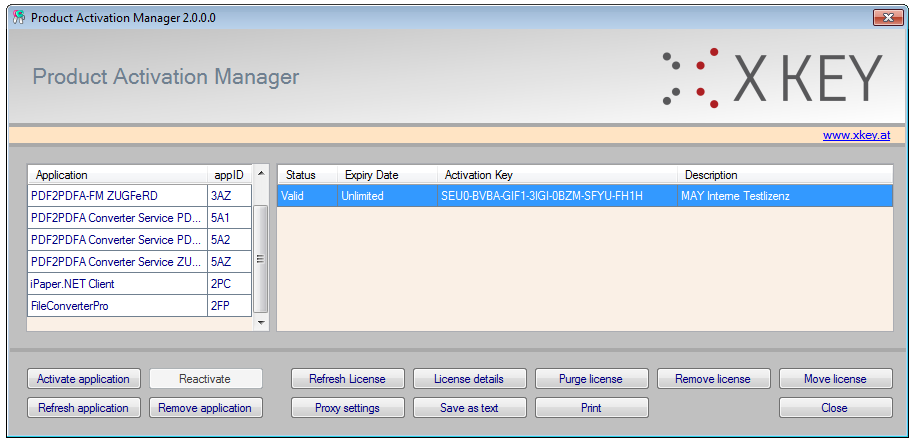
4.) Return existing licence to the licence server using ‘Move Licence’: In order to be able to retrieve the licence on the new computer, the licence must be “returned” to the licence server on the existing computer using the PAM function ‘Move Licence’ so that it can then be retrieved on the new computer using ‘Activate Application’.

If ‘Move Licence’ is executed on the old computer, not only does the licence “disappear” from PAM, but so does the App ID. This also happens if the ‘Remove Application’ function is used. In this case, to get the App ID displayed in PAM again, the application must be uninstalled and reinstalled.

Caution: Do not use the ‘Remove Licence’ function located to the left of it in PAM. ‘Remove Licence’ also removes the licence and it ‘disappears’ from the PAM list. However, the licence can then only be retrieved on this old computer with ‘Activate Application’, but not on a new computer. If you have mistakenly used the ‘Remove Licence’ function, you can immediately retrieve the licence on the computer again with ‘Activate Application’ and then use the correct function ‘Move Licence’. If you have several licences that have not yet been retrieved and a licence has been deleted with ‘Remove Licence’ and is to be retrieved again on this computer, select the licence with the preceding (+) from the list. The (+) sign indicates that this licence is already assigned to the computer and therefore no other licence should be selected from the list.

5.) Retrieve the returned licence on the new computer with ‘Activate Application’: After the licence has been returned from the old computer to our licence server with ‘Move Licence’, this free licence can be retrieved again on the new computer with ‘Activate Application’. Make sure that the same App ID is displayed in the left-hand list in PAM and that you have selected it before using the ‘Activate Application’ function.

6.) Checking and archiving licence data: Additional licence options may also be associated with the licence. e.g.: PDF/A, PDFSign, PDFCompressor, etc. Therefore, check the scope of your licence with the PAM function ‘Licence details’ to ensure that all options of your licence are available. You should also save and archive the licence information as a TXT file using the PAM function ‘Save as text’.

Information and videos about the PAM / licence functions can also be found here >>>

PAM – Product Activation Manager – new Version 2.0

Many of our software products have online product activation. During the first installation of the software, a 30-day demo version is automatically activated. For license management and product activation, every setup along with the application also includes our PAM (Product Activation Manager). Now there is the PAM version 2.0. This will be used from now on in all our new setups.

Innovations PAM 2.0:

  • PAM 2.0 is now always installed in the installation folder of the application and called from there. Previously, a common installation folder was used for all applications.
  • Combined version – 32bit and 64bit. There is no longer a split in 32bit and 64bit applications and licensing – so the display is now the same for all licenses, whether for 32 or 64bit applications.
  • Existing licenses (32bit and 64bit) are read from the registry and also written back – PAM 2.0 is therefore compatible with the previous versions of PAM, in both directions.
  • There is a separate setup to install and use the PAM 2.0 on any machine, even without a new application setup.
  • The communication with our PAM license server is encrypted using HTTPS via SOAP Web Service
Videos – PAM use / licensing:

Download – PAM 2.0 – Product Activation Manager >>>

Move license (to new PC)

You can use this option in the ProductActivationManager to release the license for use on a new device. It is necessary to enter userID and password to execute this option! The product remains as a DEMO version on the PC.

OLD PC:

  1. openProductActivationManager
  2. select license
  3. klick „Move License“ Button
  4. enter Username / Passwort
  5. OK

NEW PC:

  1. open ProductActivationManager
  2. select application
  3. klick „Activate Application“ Button
  4. enter Username / Passwort
  5. select available license
  6. OK
Webshop