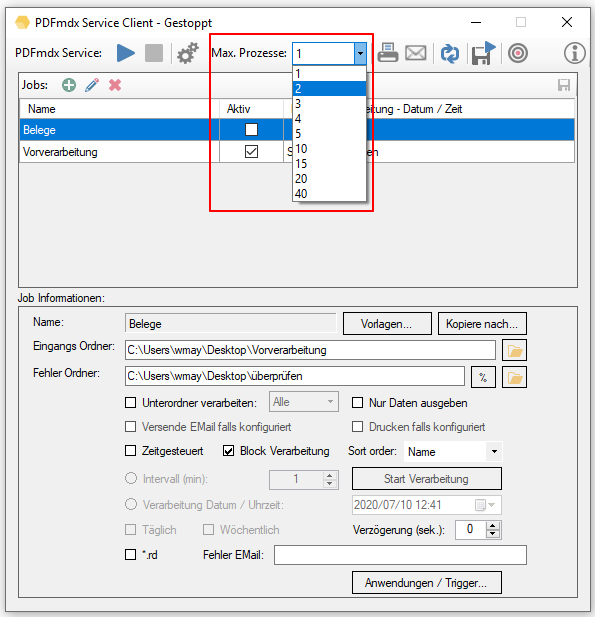
PDFCompressor-CL command line version 1.2.0 – variables for the target file name

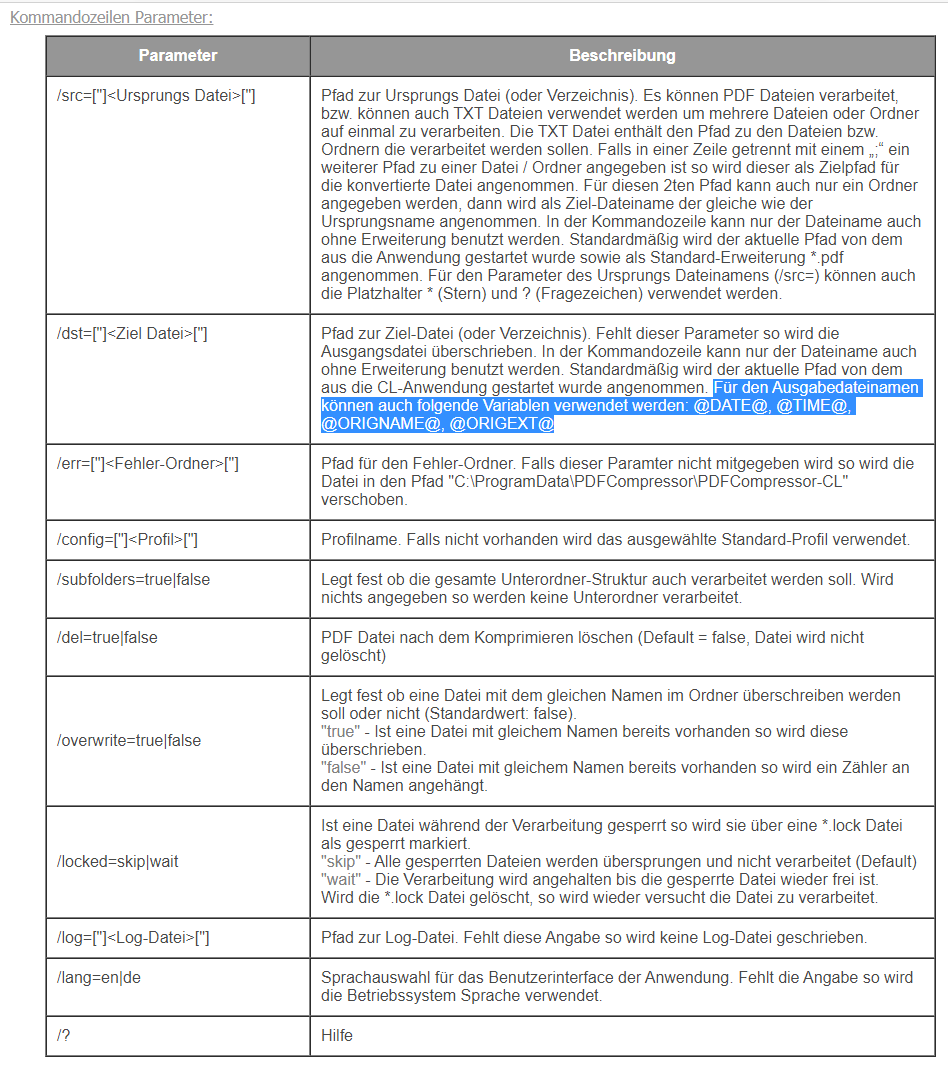
With the PDFCompressor-CL command line version 1.2.0 several variables are available for the output file name.

  • @DATE@ – date
  • @TIME@ – time
  • @ORIGNAME@ – output file name
  • @ORIGEXT@ – output file extension

This makes it possible to process all files in an entire folder structure and to store the files in the same folder structure and e.g. add an addition to the original file name.

“C:\Program Files\PDFCompressor-CL\PDFCompressor-CL.exe” /src=”c:\temp” /dst=”c:\temp\@ORIGNAME@_compressed.@ORIGEXT@” /config=neu /subfolders=true /log=”c:\temp\log.txt”

 

Download – PDFCompressor-CL – Optimizes and compresses PDFs >>>
Download – Readme / Help – PDFCompressor-CL >>>
iPaper Client – Version 3.0.68 – Overlay / fill in PDF forms, link action profiles with the stationery

Innovations – iPaper 3.0.68:

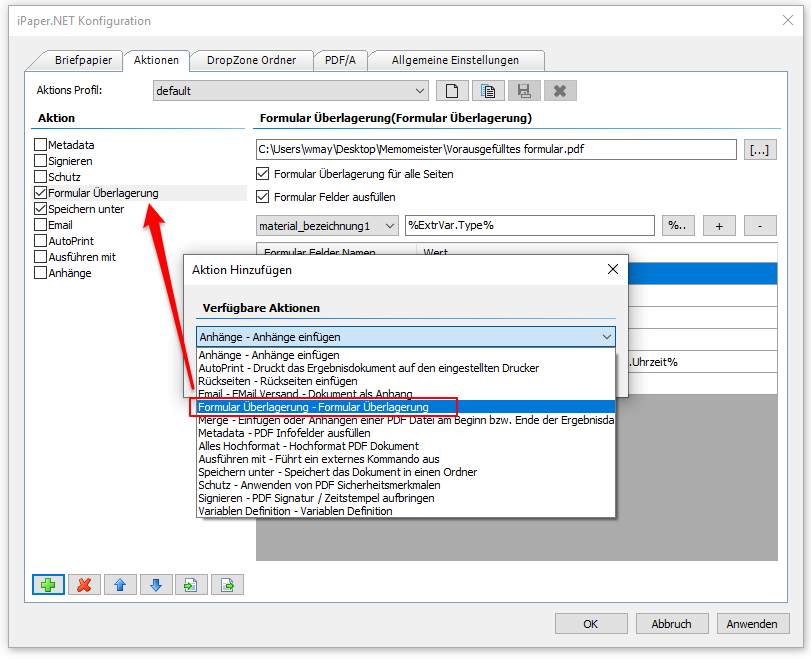
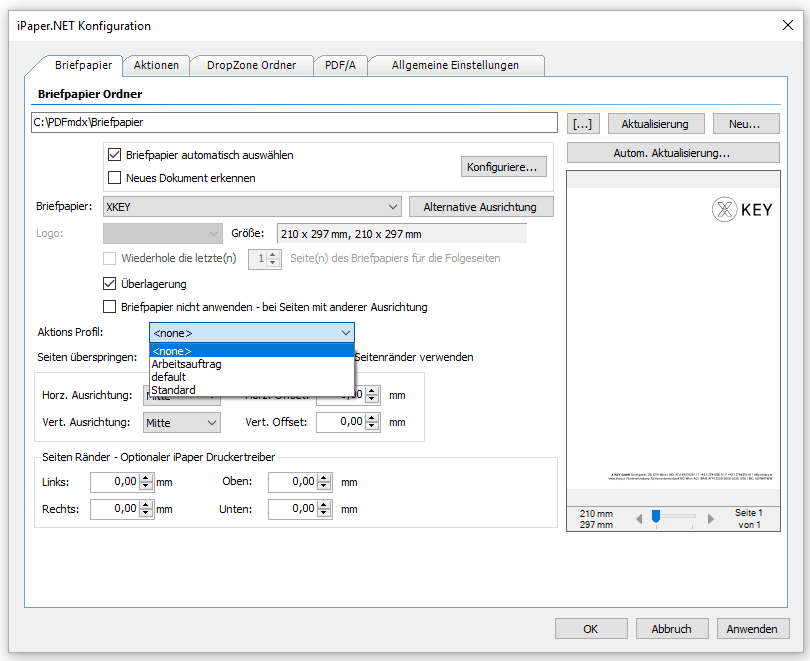
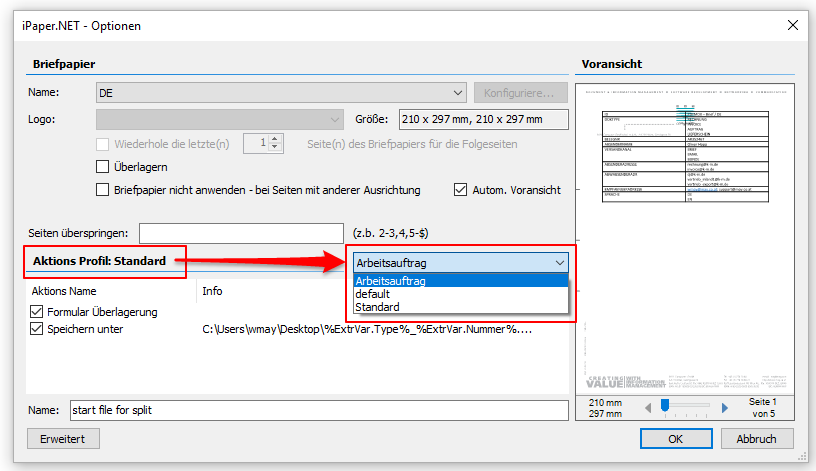
  • Link stationery to an action profile: Action profiles offer the option of saving several actions with all settings in the desired processing sequence under a name and selecting them for further processing during runtime. Now it is also possible to link an action profile to a letterhead. If the stationery is selected manually or automatically using the mdx option, the associated action profile is automatically loaded and used for further processing. If <none> is selected for the link, the user can interactively select and load the action profile during runtime using the “Query options” function.

With this possibility, the further processing of the documents can be automated with the help of the iPaper mdx option. Documents can be recognized based on their content and further processing can be controlled and automated via it. The user no longer has to decide each time and select which further work steps have to be carried out for which document.


  • New action to overlay PDF forms:
    • With the new action “Form overlay”, a PDF form can be selected which is overlaid on the iPaper result PDF in order to generate a new PDF form.
    • The template form can also be replicated on the following pages. So that the field names in the newly created form are unique, the fields added per page are numbered.
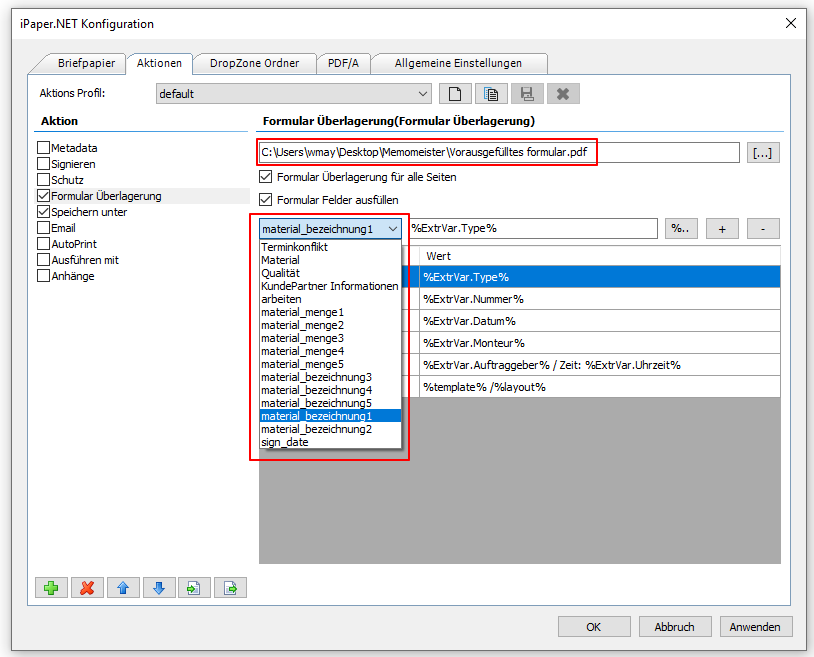
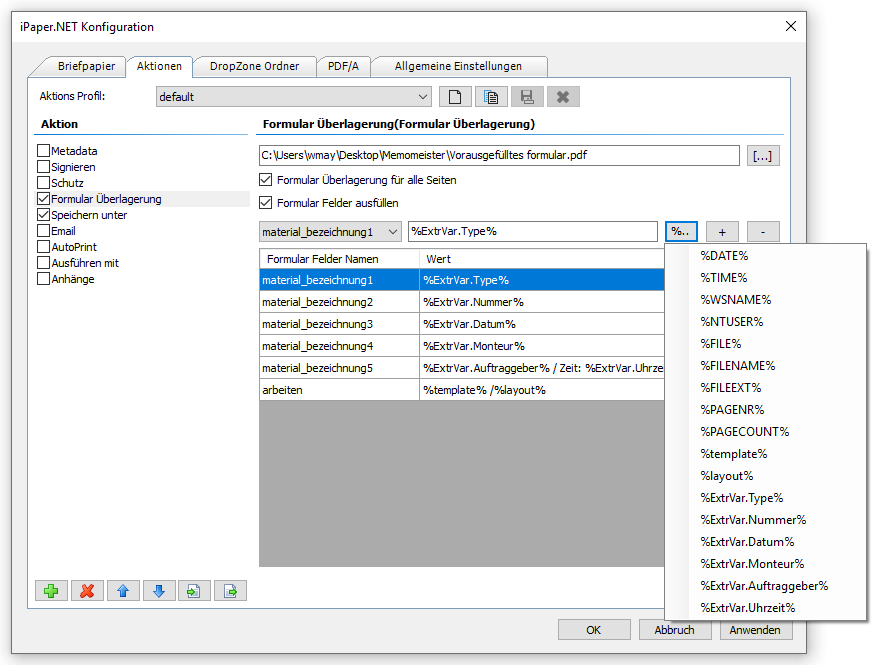
    • The form fields can be filled with data from the document – with text or variables read from the document using the iPaper mdx option.
    • A separate variable is available for each field for the field contents that already exist in the form. Existing field contents can be transferred to the newly created form.


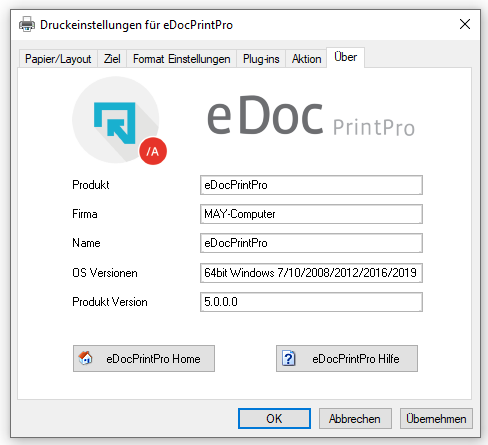
  • Updated iPaper PDF printer driver:  The iPaper PDF printer driver has been updated to eDocPrintPro Version 5.0.0. This version now supports and installs the current GhostScript GPL version 9.53.3.
  • Updated iPaper mdx option: The mdx functions integrated in iPaper have been brought up to date with PDFmdx.

iPaper 3.x Client Version

Download GhostScript 9.53.3 64bit Setup

DropOCR 1.5.0 – Sending email is integrated

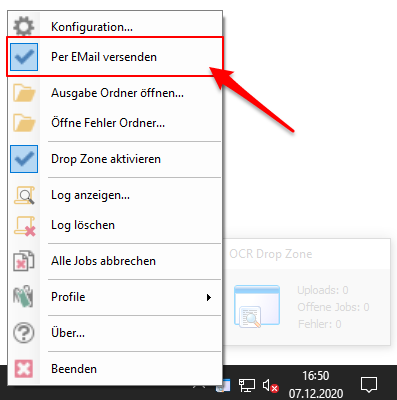
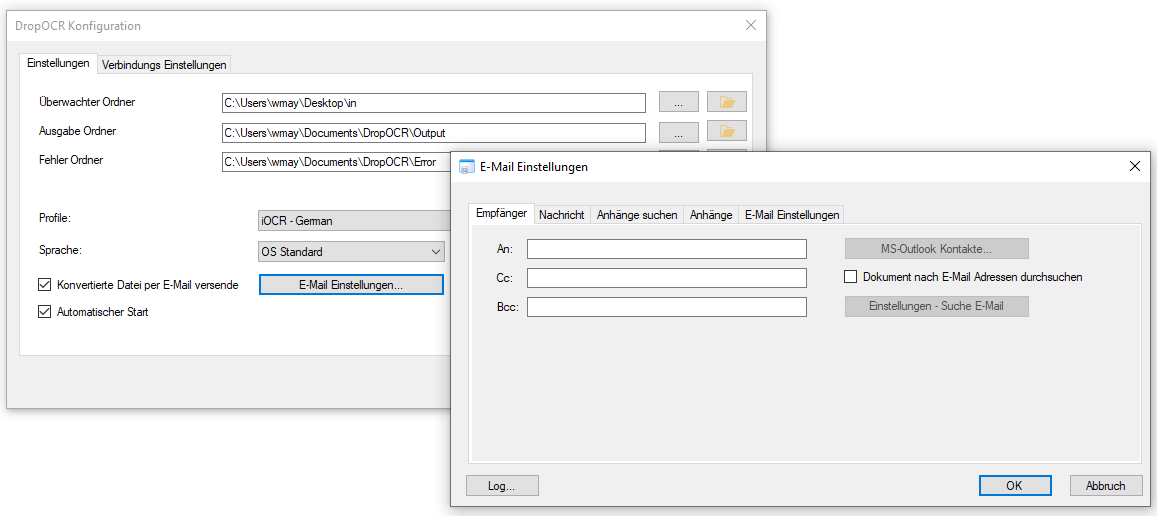
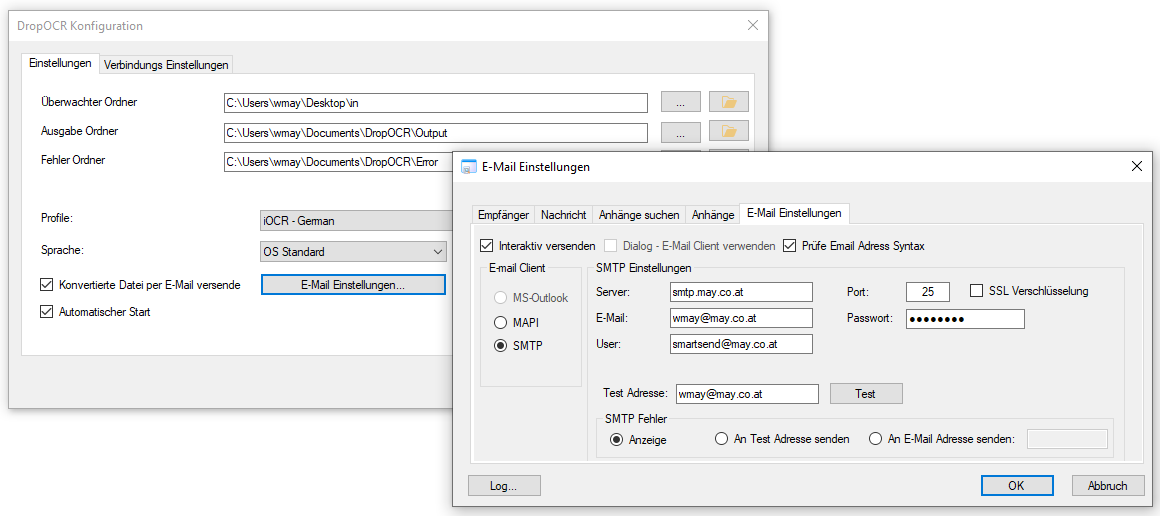
DropOCR saves the converted PDF documents in a configured folder. Now it is also possible to generate an email message and insert the generated PDF’s directly as an attachment. Depending on the configuration, the email message can also be sent directly via SMTP without user interaction.

DropOCR EMail features:

  • Presetting the email recipient (To, Cc, Bcc).
  • Search document for email addresses and use for sending.
  • Presetting the subject. The document content can also be searched for a subject text to be used using the delimiter.
  • Presetting the email message using the integrated HTML editor.
  • attachments via path & amp; Search for names in the document using the delimiter and append them.
  • Include additional files to be sent as attachments.
  • Configuration of the email transport method (MS-Outlook, MAPI, SMTP).
  • Logging of the email processes.


Download – DropOCR Web-Service Client for AutoOCR >>>

Web service applications – own SSL certificate can be selected

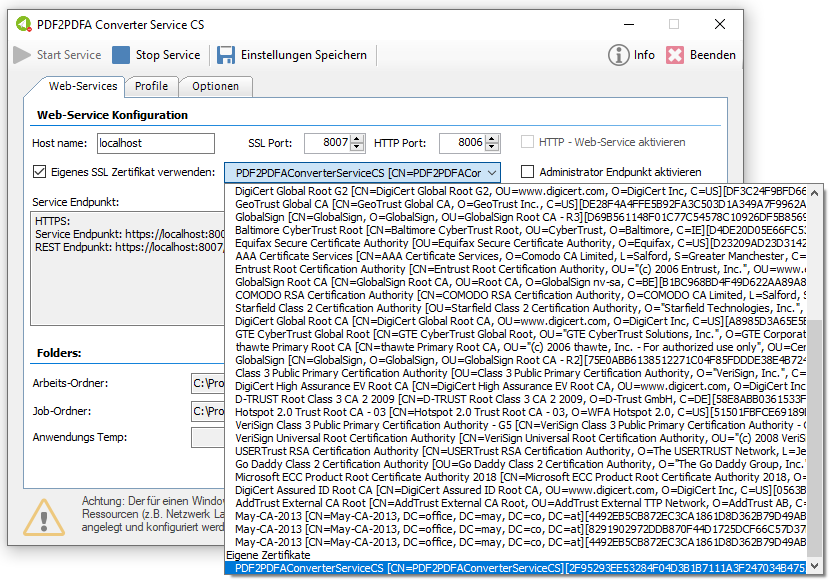
Web service applications require an SSL certificate for the encrypted REST / SOAP (https) communication between the service and the clients. The SSL certificate is stored on the computer and can either be a self-created certificate or a certificate from an official certification authority. So far, our applications, which have a web service interface, have automatically installed and used self-created certificates with the setup. It is now also possible to select and use other certificates installed on the computer.


Download – PDF2PDFA-CS – PDF to PDFA Converter Service >>>
Download – PDFCompressor Service incl. REST / SOAP Beispiele >>>
Download – HTML2PDF-CS – Converter Service via REST & SOAP  >>>
Download – PDF2DOCX-CS – Converter Service – Windows service with REST / SOAP Interface >>>

eDocPrintPro free, PDF/A & ZUGFeRD, SDK Version 5.0.0 available

Innovations Version 5.0.0:

  • The list of supported operating systems ( 64bit Windows 7/10/2008/2012/2016/2019 ) has been updated and supplemented.
  • eDocPrintPro now uses the current GhostScript Version 9.53.3.
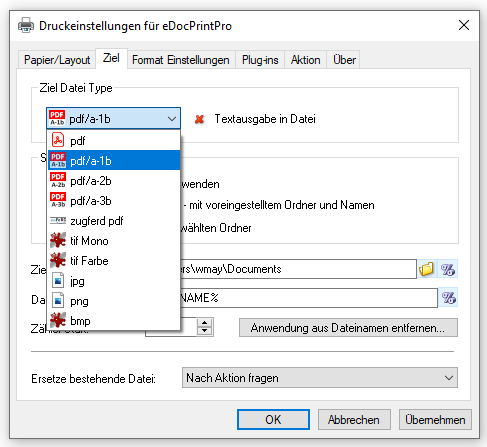
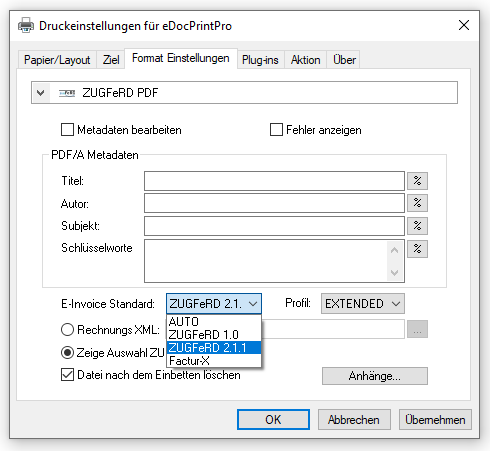
  • PDF/A and ZUGFeRD have been brought up to the current status and now offer the same functionality as the PDF2PDFA converter .
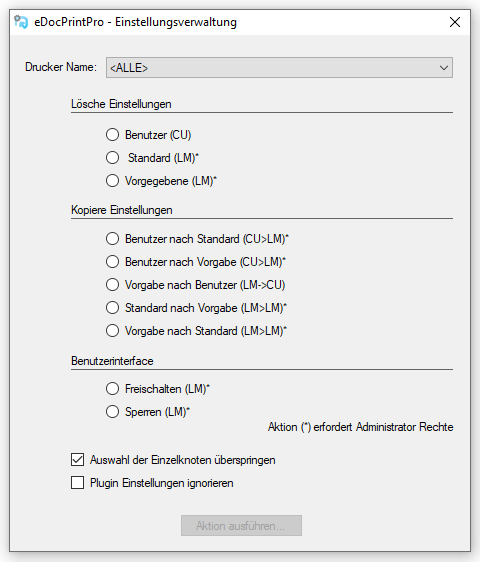
  • The “ eDocPrintPro Manage Settings ” application has been revised, expanded and can now also be used via command line calls.
  • The previously fixed standard page formats – can be deleted, imported or exported.
  • Various output formats (PS, EPS, PCL, SWF) that will no longer be supported in the future have been removed.
  • If the file to be overwritten is still open during the output without the “Save As” dialog, a dialog now appears stating that the action cannot be carried out.
  • Printing an existing PDF/A file as PDF: The PDF/A flag will be removed from the data structure, until now it was wrongly retained.
  • With version 5.0.0 a new eDocPrintPro SDK is also available.


Download – eDocPrintPro free 64bit Version

Download – eDocPrintPro 64bit PDF/A & ZUGFeRD

Download GhostScript 9.53.3 64bit Setup

Download – eDocPrintPro 32bit Version 4.0.2

Download – eDocPrintPro 4.0.2 32bit (ca. 66 MB) >>>
Download – eDocPrintPro PDF/A & ZUGFeRD 32bit (ca. 105 MB) >>>
Download – GhostScript 9.27 MSI Setup – 32bit (ca. 26MB) >>>

ImageProcessing-FM – PDF, TIFF, JPEG – Image processing via folder monitoring

Features ImageProcessing-FM:

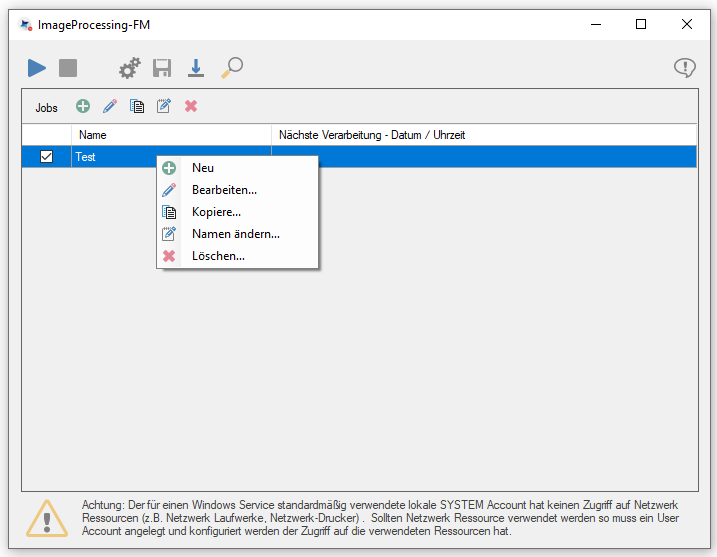
Image processing is used to improve and optimize the quality of scanned documents (PDF, TIFF, JPEG) or to improve the image quality for machine readability in preparation for a subsequent OCR recognition. This allows blank pages and black borders , Holes, lines and impurities are removed. The FM version is installed as a Windows service and can monitor one or more input folders.

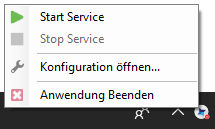
  • MS Windows service
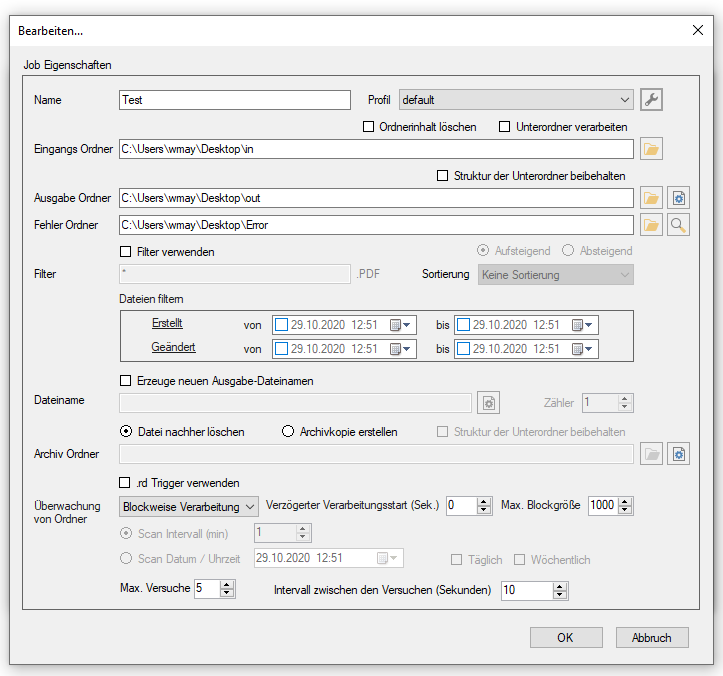
  • Multiple jobs can be created to monitor multiple input folders.
  • Multithreading / parallel processing ensures a high processing throughput
  • Configuration of the processing steps via profiles (new, copy, edit, delete, export, import)
  • Only the start folder or the entire subfolder structure can be processed.
  • Folder contents can be deleted after processing or the folder structure can be retained.
  • The folder structure from the input folder can also be transferred to the target folder.
  • File processing via filter – name, extension, created from / to, changed from / to.
  • Sorted processing by name / date as well as ascending / descending possible.
  • Generation of a new file name via variable (date, time, counter, original name / extension)
  • Delete the original file (move), copy or create an archive copy
  • Folder monitoring and processing start via file system events – immediately, or with an adjustable delay (0-999sec.), or over time interval (in min.)
  • Start of processing at a set date / time with optional daily / weekly repetition.
  • Adjustable number of retry attempts / time interval if a file should be blocked.
  • Logging (all events, only the error events)

Image processing functions:

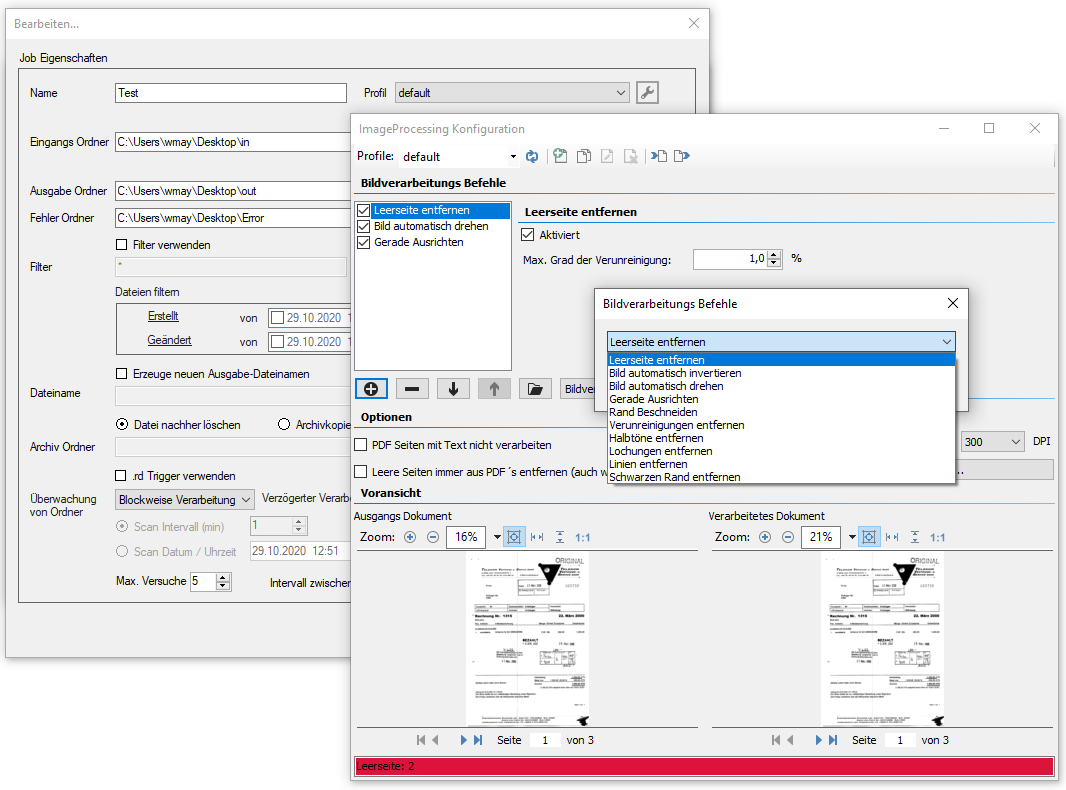
  • Several functions can be executed one after the other in a predefined order.
  • The selected functions, their parameters and processing sequence are managed via profiles.
  • Profile functions: new, copy, delete, rename, export to file, import from file.
  • Option to process PDF scans / pages with image information only or all PDF pages.
  • Loading a sample page and testing the image processing commands with a preview of the output and result files.
  • The resolution, compression and quality parameters can be configured for PDF rendering.

Individual image processing functions:

  • Detect and remove blank pages.
  • Auto rotate pages
  • Straighten pages
  • Invert images (black to white)
  • Remove the black border
  • Trim the edge
  • Remove impurities
  • Remove perforations
  • Remove lines
  • Convert color / grayscale to black / white


Download – ImageProcessing-FM FolderMonitoring>>>

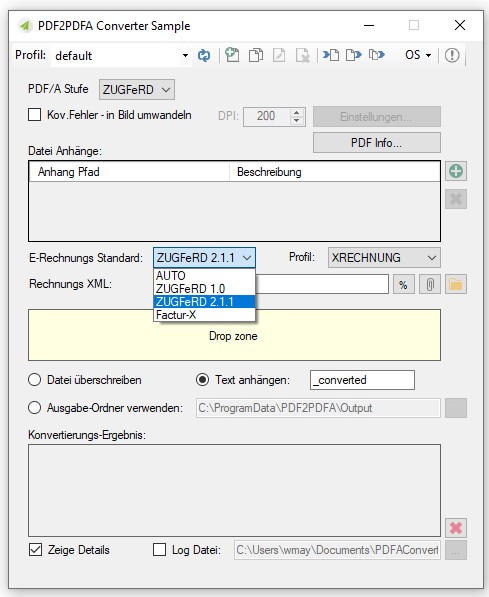
PDF2PDFA .NET Converter – Version 1.7.0 – ZUGFeRD 2.1.1 with XRechnungs profile

ZUGFeRD is a hybrid format and contains the structured invoice data in a PDF/A-3 file. This is used for visual presentation, printing and archiving. The structured XML invoice data embedded in it can be read out and processed by the recipient.

The PDF2PDFA converter enables the conversion of existing PDF into ZUGFeRD compliant documents. However, the XML file to be embedded must already be available in accordance with the required standard and is not generated by the PDF2PDFA converter itself.

In the new version of ZUGFeRD 2.1.1, another profile is made available with the XRechnungs profile. This new XRechnungs profile corresponds to the special requirements of the public administration in Germany. Not only does it meet the requirements of the European standard EN16931, it also includes the national business rules and administrative provisions of the German XRechnung standard. The new, dedicated XRechnungs profile clearly distinguishes between requirements in Germany and at European level (e.g. for mandatory fields and information within the invoice).


Download – Demo & Testapplication – PDF2PDFA Converter >>>
Download – PDF2PDFA-FM – PDF to PDF/A Converter with foldermonitoring >>>
Download – PDF2PDFA-CL – PDF/A – Commandline Converter >>>
Download – Readme / Help – PDF2PDFA-CL  >>>
Download – PDF2PDFA-CS – PDF to PDFA Converter Service >>>

AutoOCR-CL – Version 1.1.8 – OCR command line application

Innovations AutoOCR-CL Version 1.1.8:

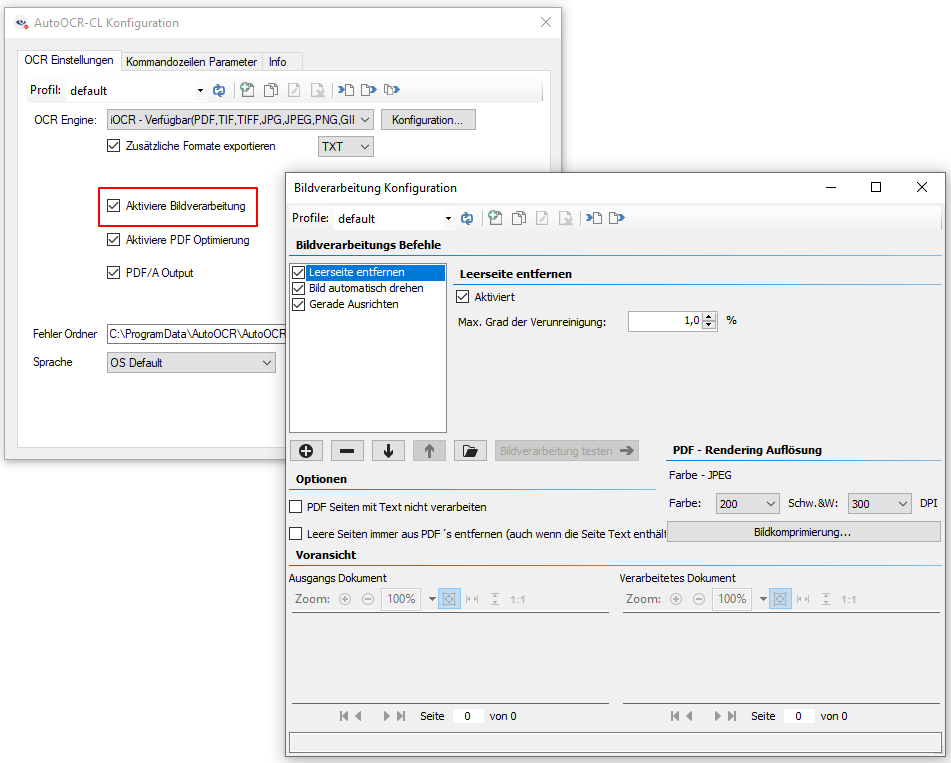
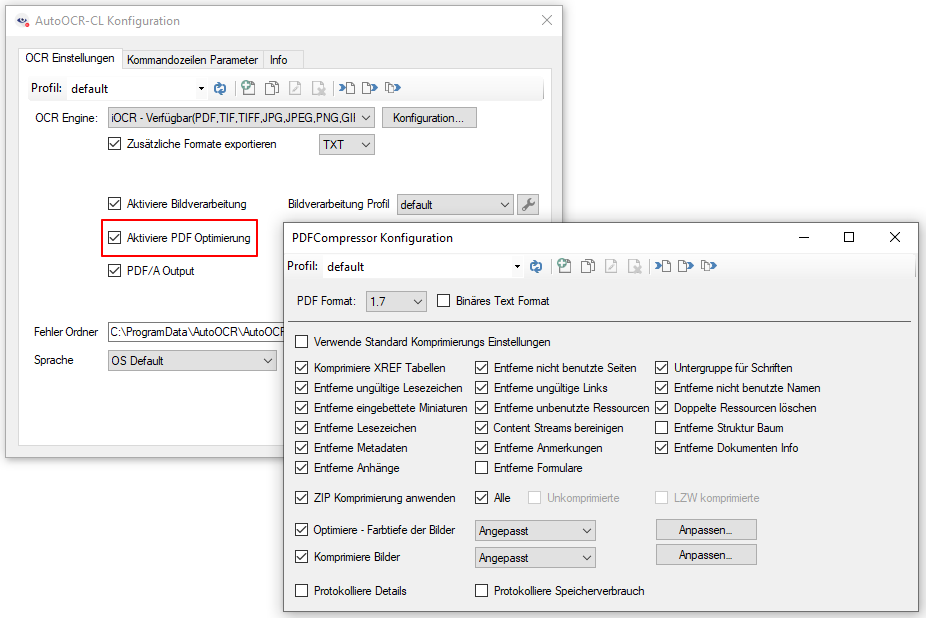
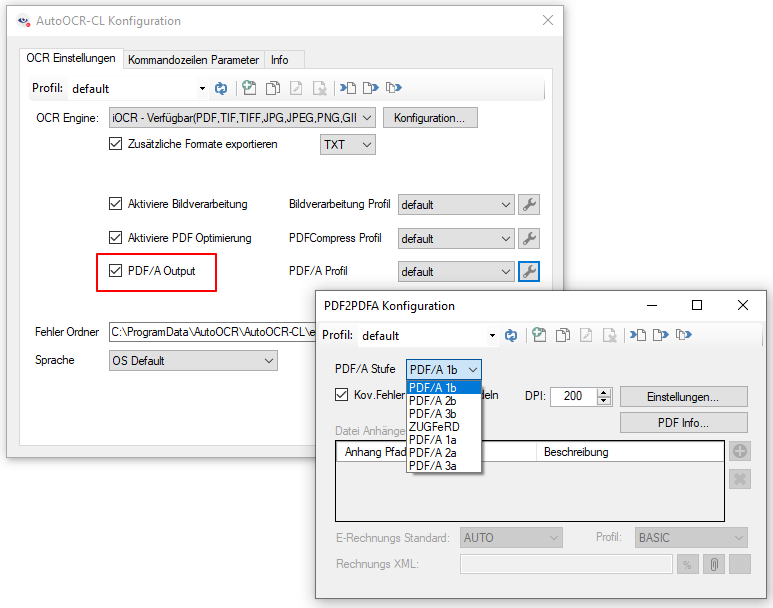
With version 1.1.8 the functions of the command line version have been brought to the same range of functions as those of the AutoOCR server. AutoOCR-CL has been expanded to include image processing, PDF compression and the generation of PDF/A-compliant output files.

  • ImageProcessing: DThis function is included in the standard scope and is used to preprocess scanned documents, especially for the iOCR engine. The image processing already included should preferably be used for the Omnipage Engine. Under no circumstances should both image processing systems be activated as this will reduce the OCR recognition rate.

  • PDFCompressorOptional to license. Is used to generate output files that are as compact and small as possible. In order to achieve good OCR quality, a scan resolution of 200 / 300dpi for color or 300dpi for black and white is required. For the display or the printout, however, e.g. 150dpi. The PDFCompressor enables the compression, the quality settings and the resolution of the images to be adjusted and reduced. A reduction by the PDFCompressor has no influence on the OCR recognition quality.

Download – AutoOCR-CL – Command line application for AutoOCR >>>
Download – Readme / Help – AutoOCR-CL >>>
AutoOCR Version 2.0.30 – JPEG2000 compression creates compact PDF files

Color scans usually produce quite large files. At 300dpi, color, JPEG compression requires approx. 300kB of storage space per page. In order to create the smallest, compact PDF output files possible, the JPEG2000 compression for AutoOCR / iOCR has been improved and an additional parameter has been added. This JPEG2000 compression allows the size of the color images contained in the PDF to be reduced considerably, making the searchable PDF files considerably smaller. The JPEG2000 compression has no influence on the OCR recognition rate.

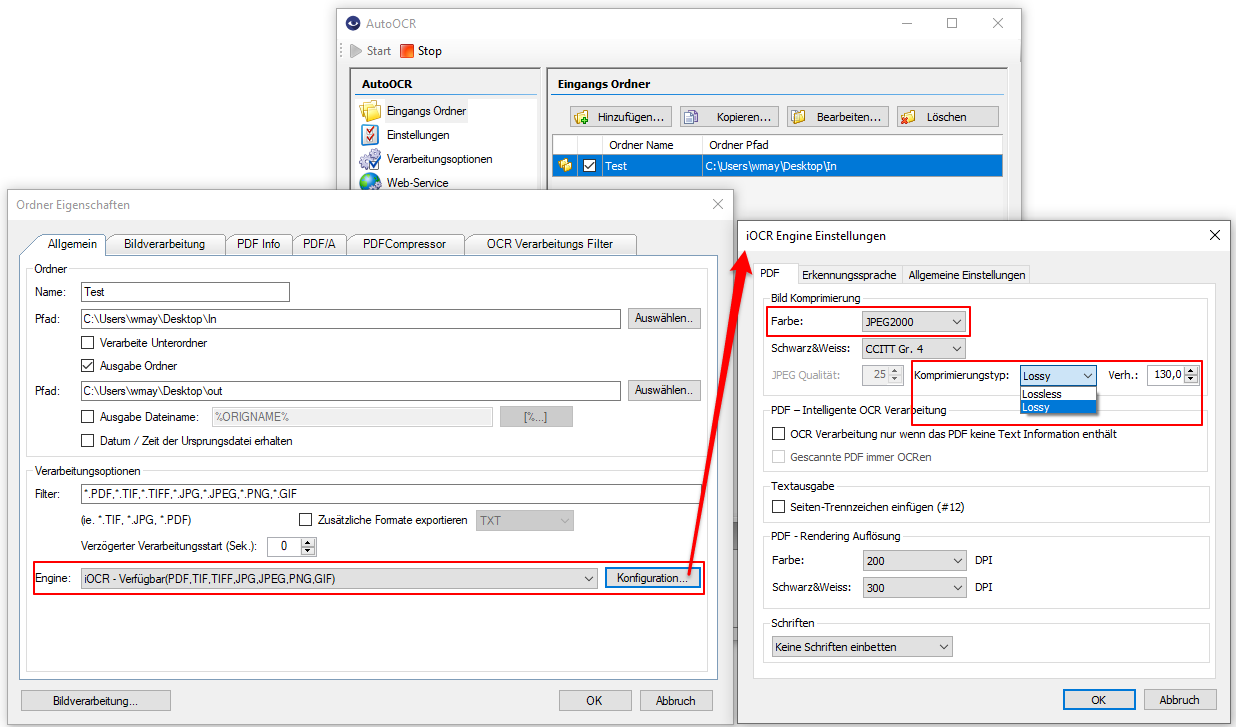
With JPEG2000, both “lossless” and “lossy” compression are available. Normally one should use the “lossy” (lossy) JPEG2000 compression to create small files – there is an additional parameter (ratio: 1 to 999) with which the compression rate and thus the size and visual quality can be controlled.

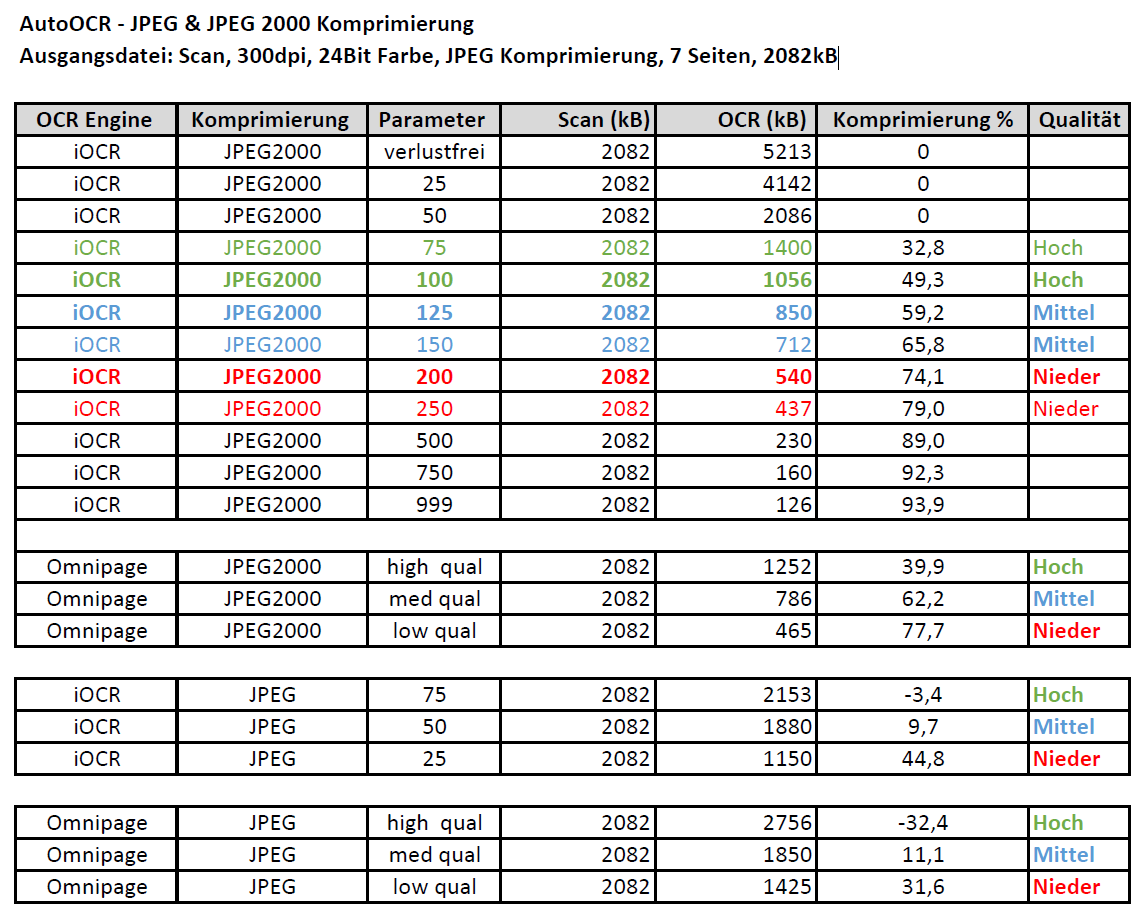
In the following table a test was made with different settings for the JPEG / JPEG2000 compression to see what effects these parameters have on the PDF file size. A scan, 300 dpi, 24 bit color, JPEG compression, 7 pages with 2082 kB was used as the initial file.

This shows that with JPEG2000, depending on the parameters, you can achieve a file size reduction of between 30 and 80%.

  • JPEG2000 / lossy / 75-100 = high quality / larger files – 32-49% reduction
  • JPEG2000 / lossy / 125-150 = medium quality / medium file size – 59-65% reduction
  • JPEG2000 / lossy / 200 – 250 = low quality / small files- 74-79% reduction

Download – AutoOCR – OCR Server inkl. OmniPage OCR (ca. 640MB) >>>
PDFmdx Version 3.13.2

New features PDFmdx template editor:

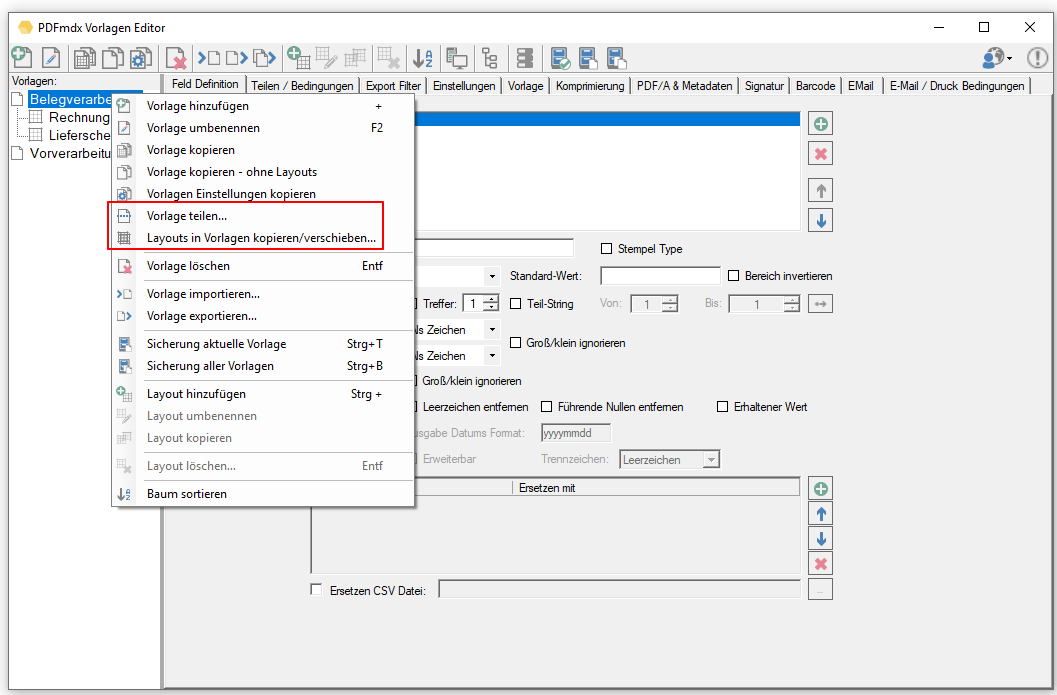
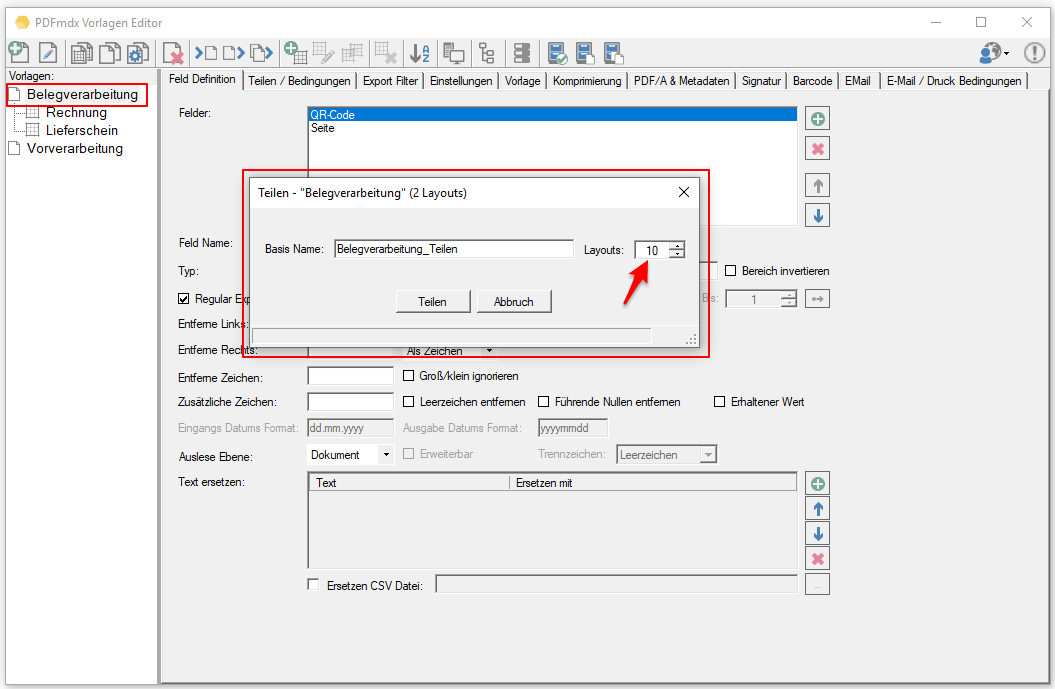
  • Split templates: Templates can contain a large number of layouts and conditions over time. E.g. if a template contains several hundred layouts, the processing of these becomes slow and confusing. For this it is advisable to use several templates and to divide the layouts. It makes no difference in terms of processing. There is now a separate function for dividing up existing templates. The number of layouts per template is specified. The PDFmdx Editor then automatically generates copies of templates and divides the layouts and the associated conditions. After that, each template only contains the specified number of layouts.


  • Copy / move layouts: Together with the “Split templates” function, the function for copying or moving layouts to one or more other templates has been expanded and implemented. So far it was only possible to copy one layout into another template. The layouts (one or more) and the target templates (one or more) can now be selected in a template. It is also possible to move the selected layouts and not just copy them. The fields and their position in the layout are retained or added to the target template.

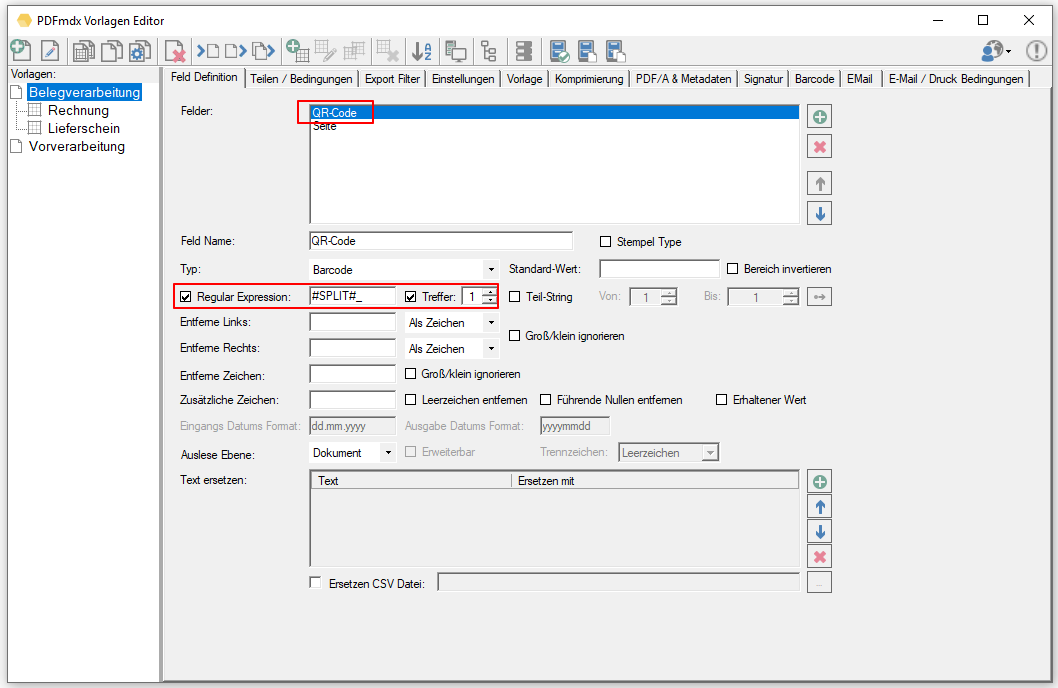
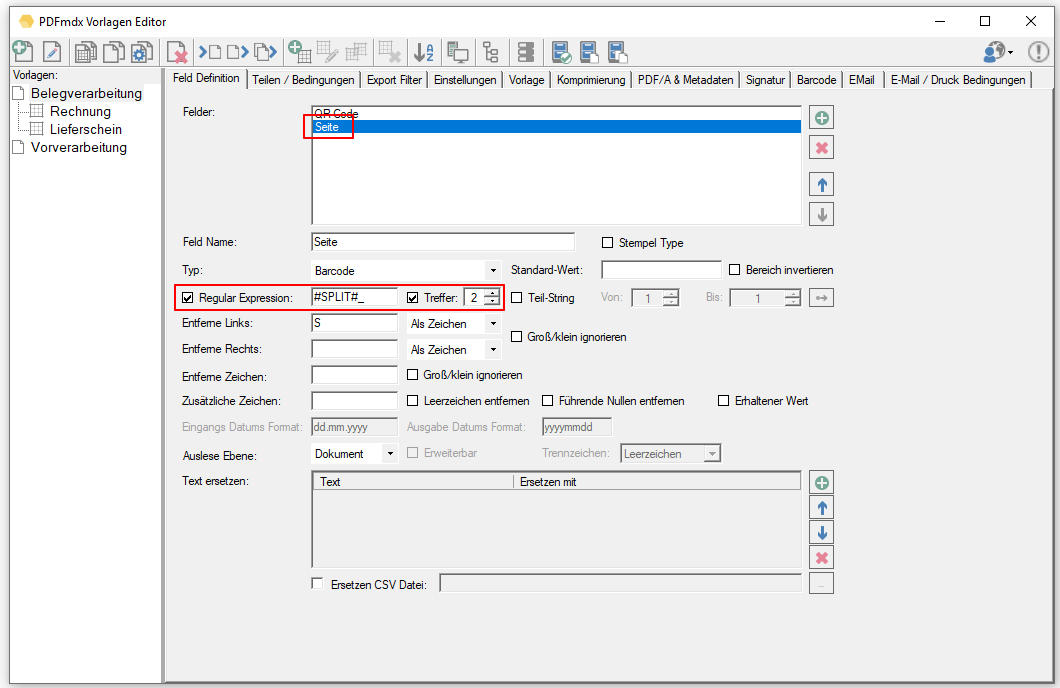
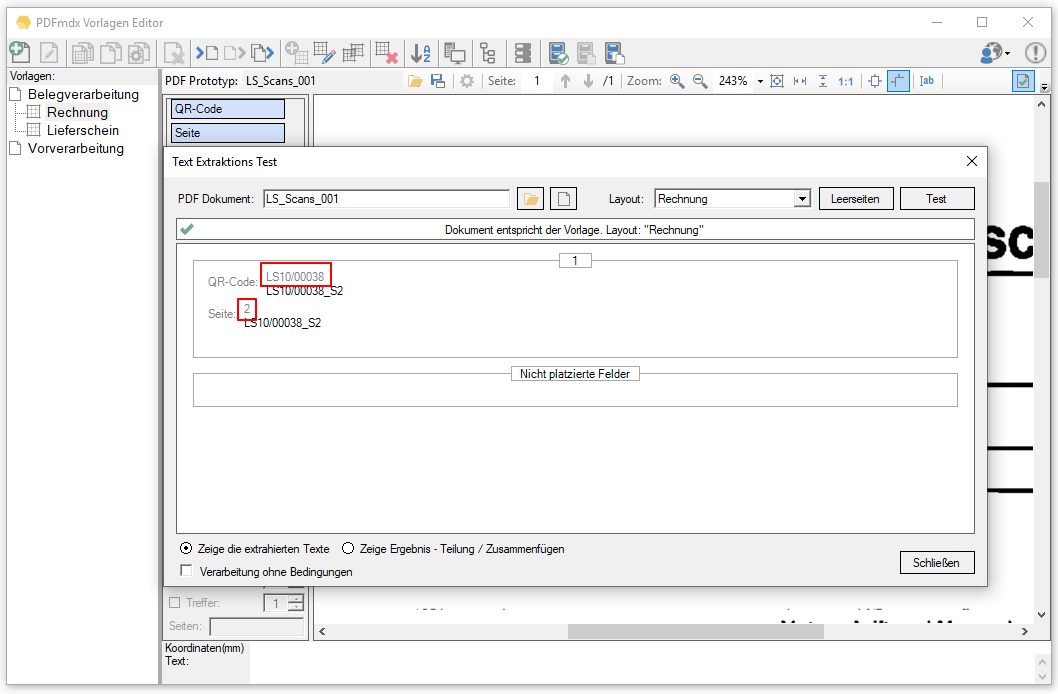
  • Read out partial areas of fields: When reading out field contents, there is now a new function to get a specific part of a text in a targeted and simple manner. E.g. if a single field contains all information and is separated by a “/” separator. e.g. “XKEY GmbH \ Gerstlgasse30 \ 1210 \ Vienna”. With the help of the newly implemented Regex function, by specifying “# SPLIT # \” plus the position in the string, you can configure which part is to be read out and used for the assignment of the variables. For example the zip code = 1210 can be read out and determined by specifying “# SPLIT # \” + “3”.


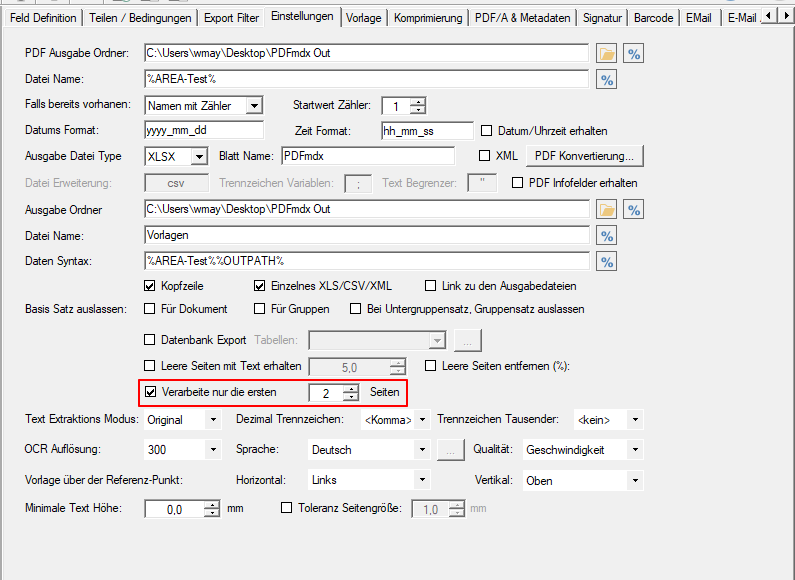
  • Configurable page limit for processing: The information required for processing is often only found on the first or first page. In order to speed up the processing of very extensive PDF documents, which can also contain several hundred pages, a page limit (e.g. 2) can now be set for the template. This defines that only the specified pages and not always all pages of the document are read in and processed.

  • Condition editor
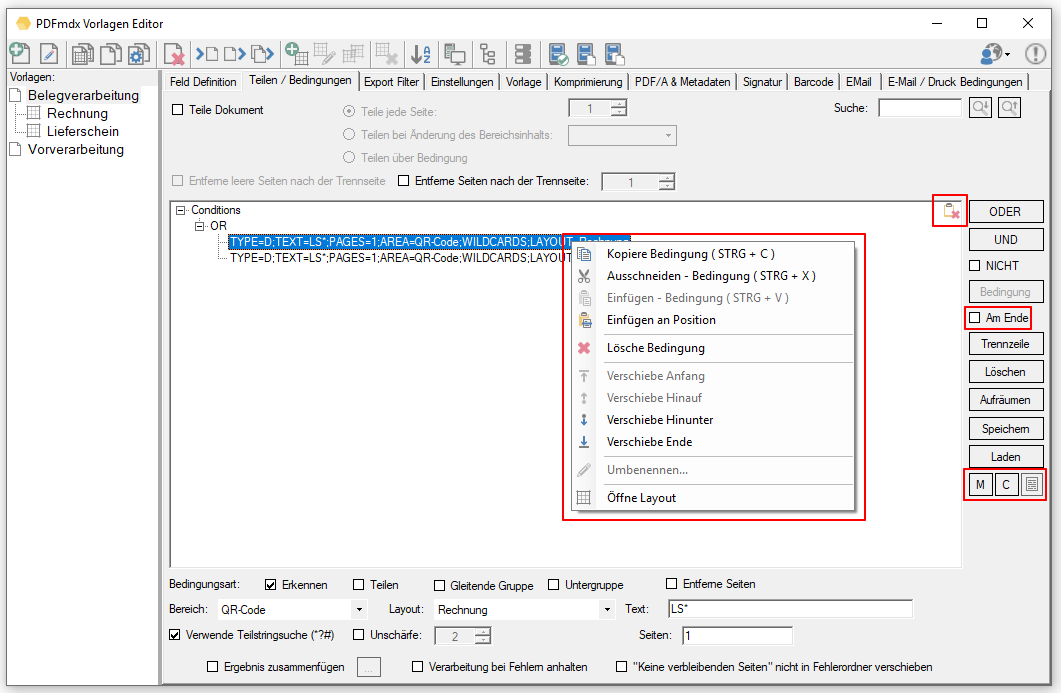
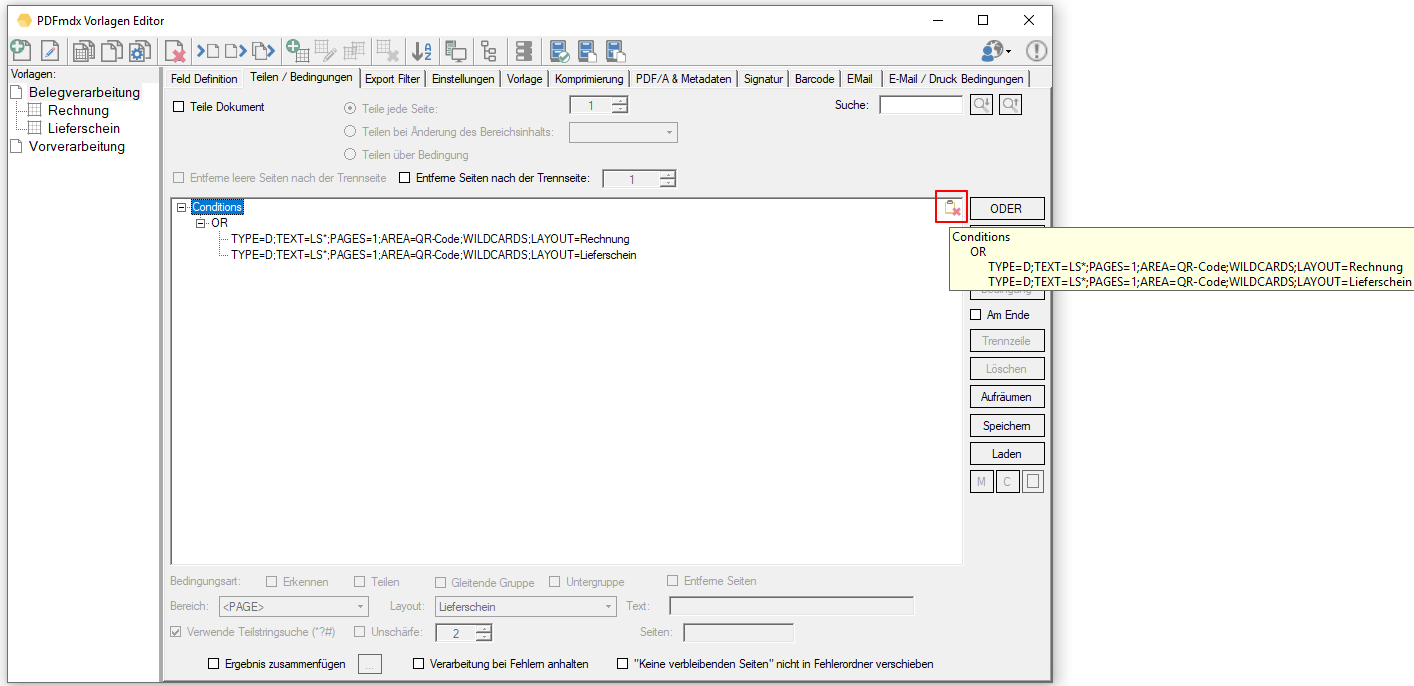
    • Individual conditions, substructures but also the entire condition tree can be copied from one template to another using the clipboard.
    • Separator lines can be copied / cut and pasted at any point in the structure.
    • (M) emory function to use an existing condition as a preliminary consideration for all newly added conditions. M – sets the currently selected condition as default, C – deletes this default again. This preset is template-specific and is saved and restored with it.
    • Checkbox to determine whether a new condition to be created is inserted at the beginning or at the end of the current level in the tree structure. Previously, a new condition was always inserted at the beginning of a node level, which meant that with large tree structures it was always necessary to move the condition downwards to get back to the starting point.


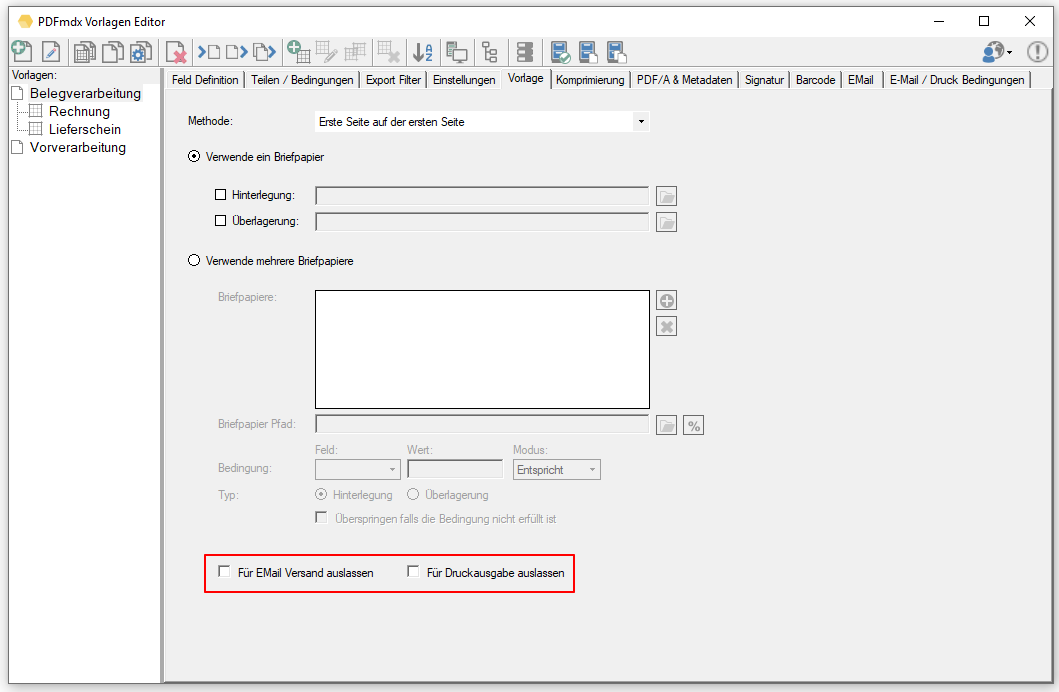
  • Do not use letterhead when printing / sending emails: If documents are output on a printer or sent as email, it may be necessary not to use the letterhead for printing because the printer already contains letterhead, but the email should be sent with letterhead. This option can be specifically controlled.

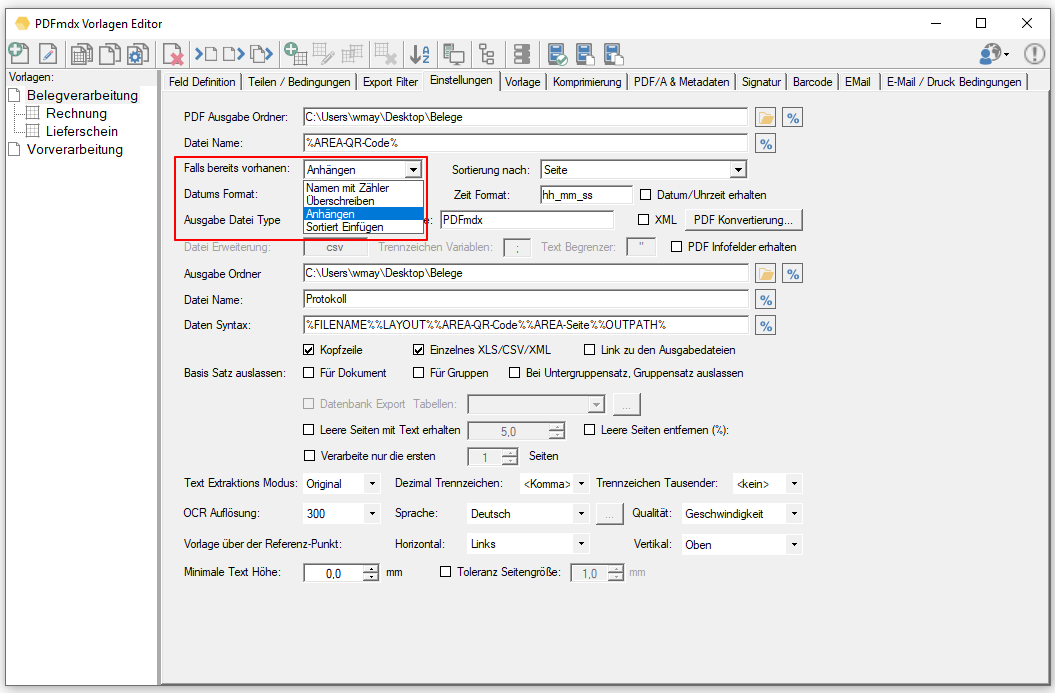
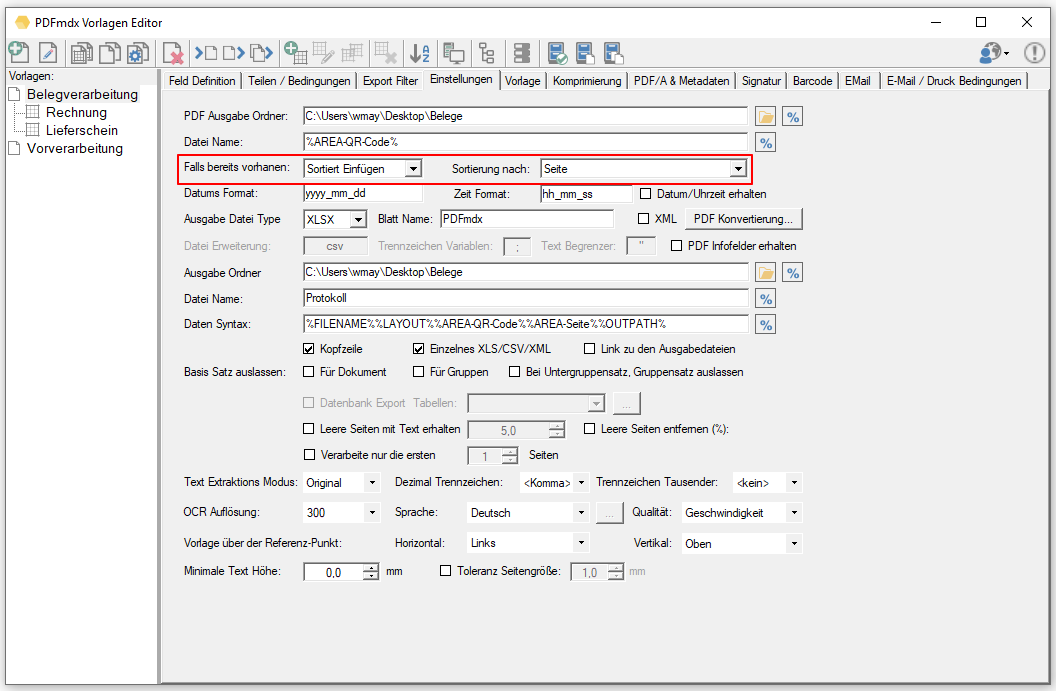
  • Combine individual documents in a sorted manner: In order not to have to pay attention to a certain order / sorting when entering documents, or to combine individual documents sorted into an overall document using the field content that has been read out, 2 new functions – “Append” and “Insert sorted” have been added to the Output configuration implemented.
    • “Attach” – If a PDF with the same name is found during the output, the new file is appended to the end of the existing file.
    • “Insert sorted” – During the configuration, a field must be selected according to which the sorting should take place. A PDF bookmark is created with the text of the selected sort field. If a file with the same name is found in a subsequent output, the new document is inserted or appended in the correct place in the PDF using the sort field. “Empty” or the same content is added at the end.


  • PDF display rotation is taken into account: PDF files can contain (0,90,180,270) parameters via a “display rotation”. E.g .: Can the display of documents that have been scanned rotated be corrected accordingly using the “Display Rotation” parameter in order to always display the pages in portrait format. However, the parameter is only used for display on the screen; internally, however, the PDF data structure is still rotated (e.g. upside down). The current version of PDFmdx recognizes the PDF “Display Rotation” and takes it into account so that the display corresponds to the processing and the fields are read from the correct positions.
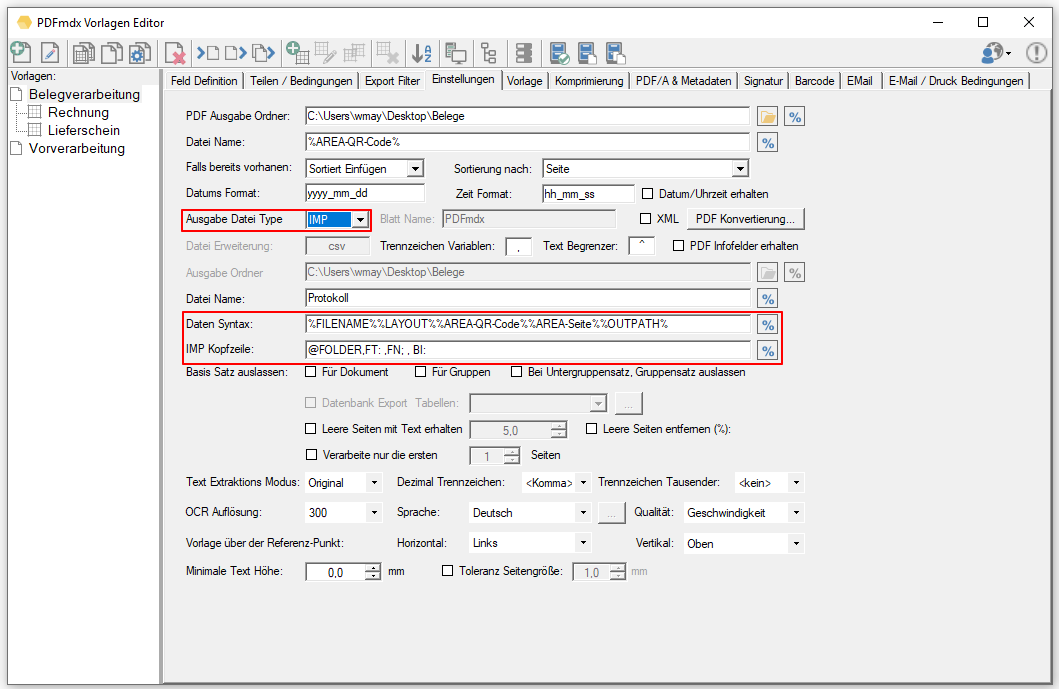
  • EasyArchiv (IMP) Export Format: The EasyArchiv IMP metadata output format is a kind of CSV format. It contains an individually configurable header line as well as subsequent lines with the PDFmdx metadata. The field delimitation is the “^” and the field separator is the “,” (comma). As with all other formats, fields / variables are available for selection for the following lines.

Example of an IMP header: @ FOLDER, FT: B2B_Netz, FN: Partner, FN: B2BMessageID, FN: MailMessageID, FN: RefNr, FN: Sender, FN: B2BSystem, BI: 2001
FT: = document type, FN: = field names. This line must be configured individually according to the archive into which it is to be imported.

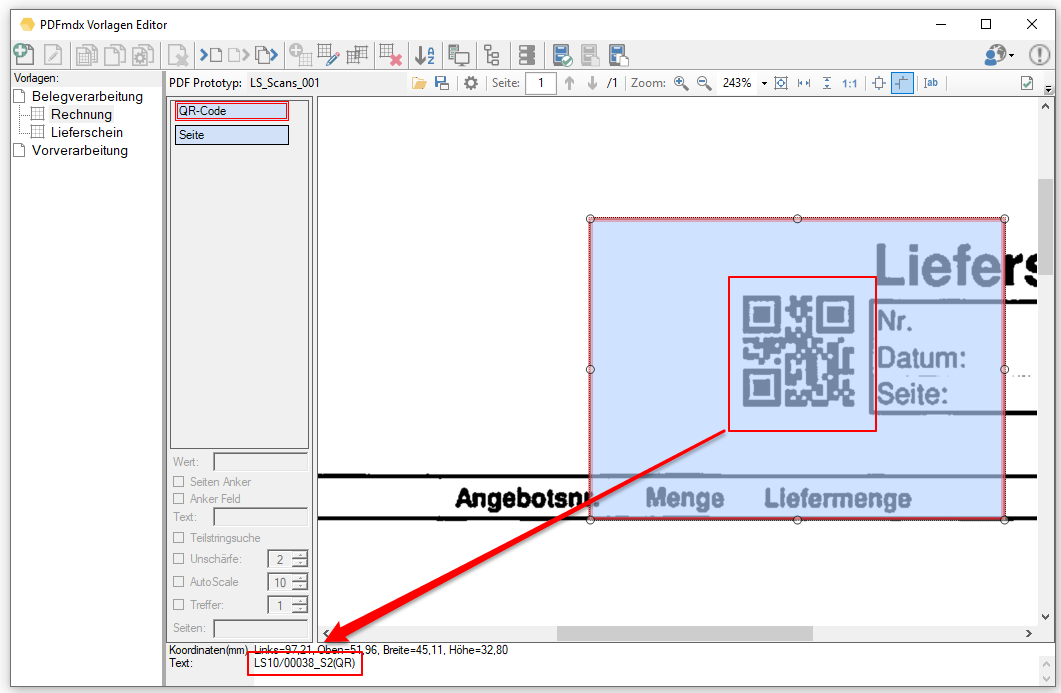
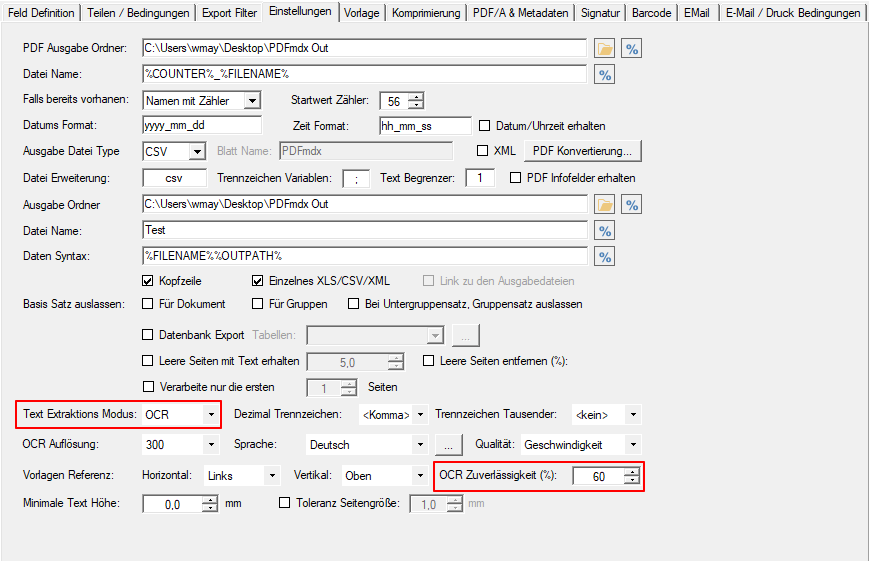
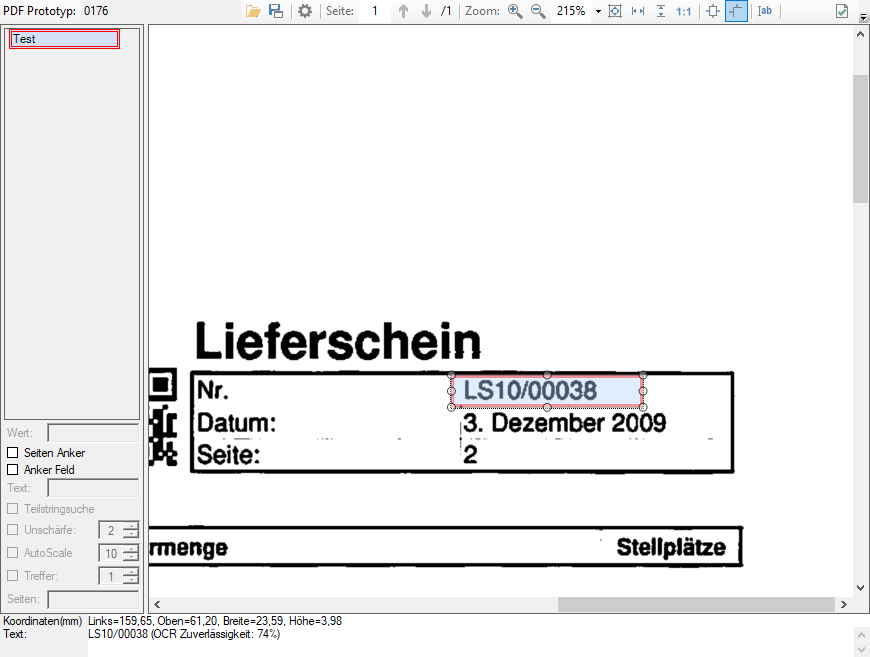
  • OCR reliability in the OCR area: PDFmdx also offers the option of determining the text from the image using an OCR function for the positioned fields. Up to now, the OCR reliability was fixed internally at 60%. This threshold value can now be configured and is also output as information in the preview for the text output in the footer of the PDFmdx editor.


Innovations PDFmdx processing:

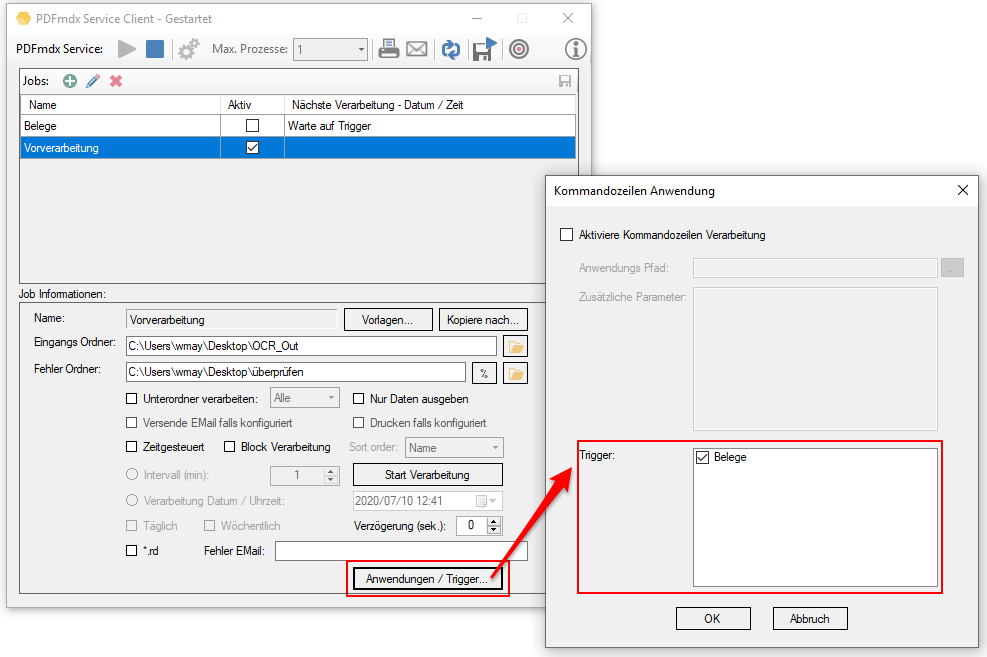
      • Job Trigger Funktion:  The start of processing of one or more jobs can be triggered by the end of processing of another job. All jobs that are started via a trigger must be deactivated in the job list, otherwise processing is triggered via the Monitoring folder and not via the trigger. With these jobs, the start of processing is only triggered by the trigger of another job. Sorted processing can also be ensured by a trigger. The next processing step is only started after all files of a previous job have been processed.

      • Sorted processing of incoming files: Files in monitored folders can now also be processed in a sorted (ascending / descending) manner according to name, size, creation and modification date. To do this, the “Block processing” option must be activated. The start of sorted processing requires a defined point in time. It can be triggered by the interval timer, at a set time, by an * .rd file, by the trigger of another job or by pressing “Start processing”.

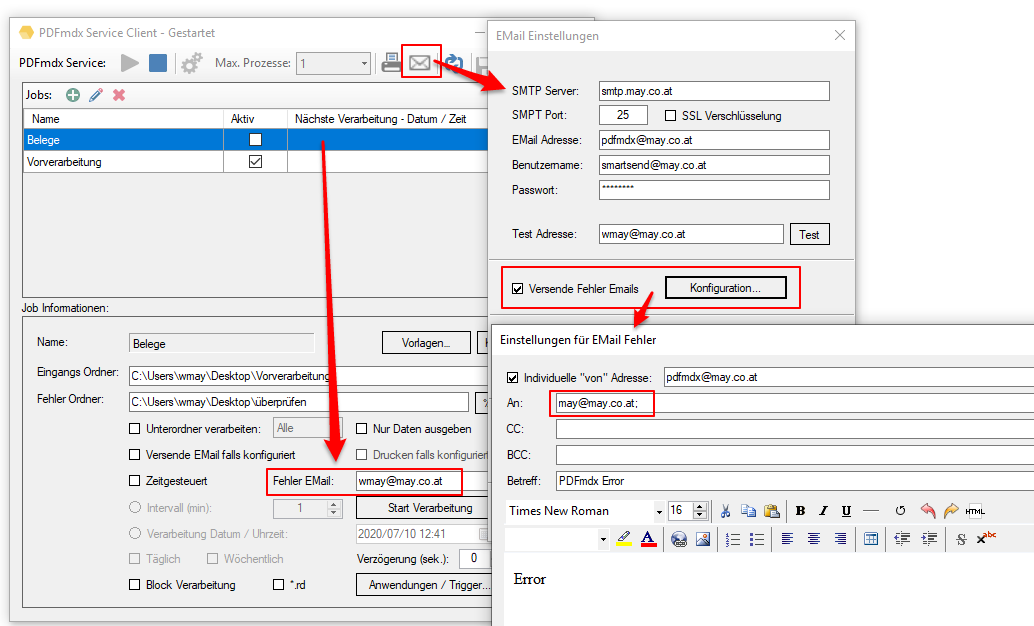
      • Error email address per job: An individual error email address can be specified for each job. This overrides the error email address that is generally defined in the PDFmdx processor and applies to all jobs.

      • Parallel processing: Is carried out on the basis of the jobs, but not in order to process several documents in parallel within one job.

Download – PDFmdx Template Editor & Processor >>>
Webshop